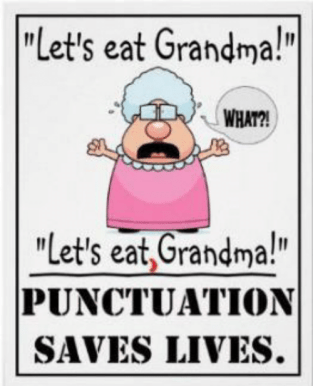
 Perhaps you’ve seen the meme floating around with a terrified grandma quaking beneath a sign that reads “let’s eat Grandma!” followed by a sign that reads “let’s eat, Grandma!” At the very bottom of the image we have the punch line: punctuation saves lives! With the single insertion of a comma, we are told, cannibalizing Grandma is no longer an option. While hilarious, such memes play into the distortion of grammar that we encounter in our time.
Our world sees grammar as a series of arbitrary rules (with dozens of exceptions!) that, at its best, is used to make sure we are being “correct” and, at its worst, is used to humiliate those who never learned the difference between “who” and “whom” or “much” and “many” or when one can use “i” before “e.” Stand-up comedian Brian Regan has an entire set dedicated to this notion called “Stupid in School” in which he retells stories from his days as a young, ignorant student. Here is an excerpt:
Teacher: “Brian, what’s the ‘I before E’ rule?”
Brian: Um… I before E… ALWAYS.
Teacher: “What are you, an idiot, Brian?”
Brian: “Apparently!”
Teacher: “No, Brian, it’s I before E, EXCEPT after C, AND when sounding like A, as in neighbor, and weigh, and on weekends, and holidays, and all throughout May, and you’ll always be wrong NO MATTER WHAT YOU SAY!”
What is funny about this exchange is that we have all felt like Brian, and collectively we can now laugh at Grammar as a silly set of rules that no one truly cares about except for sticklers. The only problem is, this whole view of Grammar is dead wrong. Among other things, it ignores the way Grammar was understood for the vast majority of history.
Grammar comes to us originally from ancient Greek (travelling through Latin and French before getting to English). Gramma (letter) + techne (art or skill), so that the Greek word grammatike means “the art of letters.” The Latin translation of grammatike was litteratura (from littera which means “letter.”). To the ancients, the distinction we make between grammar (by which we mean “correct usage”) and literature (by which we mean stories) did not exist. Rather, they were part and parcel of the same “art of letters.” So, naturally, the question becomes “what is the art of letters?” The art of letters is one of the seven liberal arts (a field of study with its own subject matter) and is also a stage in the development of the mind.
Grammar is one of the seven liberal arts. These arts, born out of ancient Greece and Rome, are called liberal because they were the arts deemed necessary for a free citizen to possess in order to participate in the world. These were divided into two groups, the Trivium (three ways) and the Quadrivium (four ways). The Trivium, which today we might call the Humanities or language arts, included grammar (the art of letters), logic or dialectic (reasoned argument), and rhetoric (the means of persuasion). The Quadrivium, which we might today call math and science, included arithmetic (numbers and operations), geometry (numbers in space), music (numbers in time), and astronomy (numbers in time and space). Each of the liberal arts built on the previous ones, and Grammar was understood as the preparatory discipline. According to one scholar, Grammar “included not only correctness in speaking or writing, but also the further study of what we would today tend to call literature, or the analysis and interpretation of existing literary works” (136). Grammar has thus historically been understood as the study of words, both in how to use them and in what they mean. The separation the correct use of words (what today we call grammar) and the interpretation of words (what today we call literature) only came about in the modern period. And just as the ancients and medievals put the best literature in front of their students in order to teach grammar, so do we at my school, believing with Mortimer Adler that “the best education for the best is the best education for all.”
In addition to being a liberal art, Grammar is also a stage of the development of the mind. The “Grammar stage,” according to Dorothy Sayers in her highly influential essay The Lost Tools of Learning, is characterized by learning by heart, memorization, recitation, chanting, observation, and collecting (9-10). For Sayers, the “Grammar stage” is one in which the basic elements of each subject are explored, memorized, collected, recited, observed, and (perhaps) chanted. Thus there is a grammar of language (of course) as well as metaphorical grammars of story, of history, of geography, of math, and of science. We can also add Bible to that list. The grammar of history, for example, is the reason for timelines in every classroom at my school, the dates of history being essential knowledge to the subject. Or in science, collecting, observing, and cataloging all kinds of plant and animal specimens so as to organize the basic knowledge of the world around us serves this grammar stage as well. The grammar of each subject is never totally abandoned. In fact, it serves as the foundation for the practice of logic and rhetoric. Without basic information about the world, stories, people, or cultures, then higher studies (which seek to answer questions like “why?” and “so what?”) are impossible. And, perhaps most tellingly, the grammar stage is characterized by wonder at the world and a delight in its treasures. Sayers specifically cautions us against “the modern tendency . . . to try and force rational explanations on a child’s mind at too early an age.” While “intelligent questions,” she argues, “should of course receive an immediate and rational answer[,] . . . it is a great mistake to suppose that a child cannot readily enjoy and remember things that are beyond his power to analyze–particularly if those things have an imaginative appeal . . ., an attractive jingle . . ., or an abundance of rich, resounding polysyllables” (11). Grammar, this art of letters, is thus the building blocks of the entire edifice of human knowledge.
Some may dispute the account of Grammar we have given here, instead arguing that Grammar is, perhaps, too abstract or difficult or (most often) pointless. In an age of word processors, Google, Wikipedia, online dictionaries, Siri, and Alexa, what could possibly be the point of spending time learning an art that is not “necessary?” The first answer seems to be the most obvious one. If grammar only means “correct usage” or (in the broadened sense used by Sayers) “basic facts,” and if producing a “correct” product is the goal, then there is some merit to the argument that studying grammar is a waste of time. But if grammar means something more than “correct usage” or “basic facts,” or if the goal is to do more than produce a “correct” or “factual” product, then grammar ought to be studied because, with John of Salisbury (the great medieval bishop and teacher) we believe that “Grammar prepares the mind to understand everything that can be taught in words” (137). That is, education is impossible without grammar.
At the end of the day, we can conclude that Grammar, which is both a stage and an art, is necessary for the true education of students. Without it, the other subjects that come after are not accessible. Without it, unfiltered wonder at God’s world is difficult to attain. Without the intentional focusing of the mind on the basic building blocks of knowledge, students would be at a loss for how to proceed. St. Augustine, in his famous book On Christian Teaching makes the argument that Grammar (understood in its ancient sense) was preparatory for understanding this scriptures. He notes that students should acquire knowledge of “the letters of the alphabet, without which reading would be impossible, and . . . the multiplicity of languages” (54). He goes on to point out that “our Christian authors used all of the figures of speech which teachers of grammar call by their Greek names tropes. . . . Those who know about these tropes recognize them in sacred literature, and this knowledge . . . helps them in understanding it. . . . I recommend that they be learnt independently” (87-8). So, with St. Augustine, let’s thank God for grammar!

 G. C. Jeffers
Leave a comment