
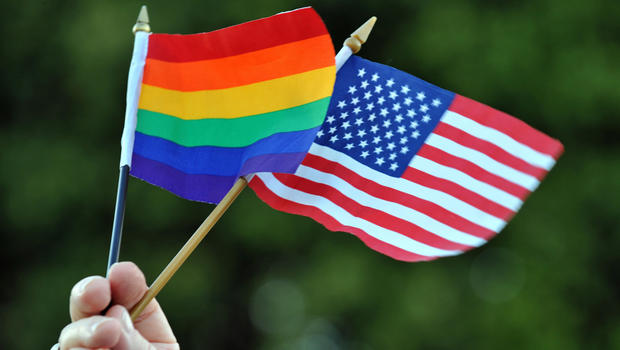
 In light of the recent decision by the Supreme Court that same-sex couples have a constitutional right to have their marriages licensed and recognized by all fifty States, I’ve decided to pen some reflections on the topic that I hope will offer folks something interesting to read and think about. While there are layers upon layers of things to discuss about this topic, I’m going to stick to what I care about most. Others will talk about the legal implications of the Supreme Court ruling (and the ongoing (and troubling) implications of enshrining sexual orientation as a protected category like race or sex), the scriptural witness against (or for) same-sex sexual relationships, the political implications for future office-holders, or the social implications for our wider culture. While these discussions are of obvious importance, there isn’t much I have to say that hasn’t already been said. Rather, I want to discuss the following: a) what our political, social, and cultural acceptance of homosexuality, bi-sexuality, trans-sexuality, etc says about how we think about ethics, b) why it is significant for Christians what the state gets up to, and c) how the church should respond in the face of losing power.
Before I write anything else, though, I want to first confess that the way the church has historically treated LGBT people has been horrendous. Homophobia (fear that spawns hatred of gay people) has no place among Christians or in the church. This should be true in the language we use and in the actions we take. It should also be clear that “gay” does not mean anything other than the fact that someone experiences sexual attraction to people of the same sex at the exclusion of feeling such attraction for people of the opposite sex. Gay people are not sinners by virtue of having an attraction. Before anything else, Christians must be committed to loving their neighbors, even their gay neighbors, to the same extent that they love themselves.
Some of you have probably noticed that I have changed my position on same-sex sexual relationships. While I used to be quite vocally gay-affirming, I have been convinced in the last year or so of the traditional position on same-sex sexual relationships. The why and the how of this change is not the purpose of this blog post ( I may one day write such a post), but suffice it to say that I have been convinced by a combination of virtue ethics and natural law arguments. I also attribute my change of heart to my embrace (as I have detailed in various places) of the great Tradition and my movement away from subordinating faith to political ideology to, instead, of embracing faith on its own terms.
* * *
There are three broad ways that I have seen Christians respond to changes in the sexual landscape in the last several decades.
Some argue that we must read Scripture with a hermeneutic of love that would end up validating same-sex sexual relationships in the context of marriage. Some of these Christians are more liberal (a technical word in theology referring to a certain set of practices that seek to accommodate modernity) in their reading of Scripture; they critique the Scriptures themselves as being problematic. Other Christians who take this position are more hermeneutically sophisticated and, like Justin Lee, find ways of getting Scripture to affirm same-sex sexual relationships. As a consequence, to the degree that such folks are politically minded, they tend to want the state to recognize same-sex marriages in the same way that the state recognizes opposite-sex marriages.
A second group argues that both Scripture and Tradition condemn as sinful same-sex sexual relationships because such relationships violate both God’s and nature’s laws. While nevertheless affirming the traditional vision of sexuality, such folks either support or at least are apathetic to the state’s recognition of same-sex marriage as a matter of civil rights. In the same way, they argue, that the state allows divorce or the consumption of pornography, so should the state grant this freedom. To deny such a freedom would be for the church to impose its will on society at large, something totally inappropriate in a pluralistic democracy and, anyway, antithetical to the apolitical mission of the church that does much better when it doesn’t have the levers of power. There is a subset of this group that argues that the state should not license or validate marriages at all, which amounts to the same thing.
A third group believes that same-sex sexual relationships are sinful and they argue that the state should refuse to validate same-sex marriages. In their view, the reason the state should refuse to recognize same-sex marriages is not because such marriages are sinful and the state should keep people from sin. Rather, they argue, the state has a two-fold obligation to protect the most vulnerable and to promote public virtue. Only validating opposite-sex marriages, they argue, because it promotes an arrangement in which children will have both a mother and a father. Furthermore, it promotes public virtue because the state recognizes that marriage exists as a social institution prior to the state. That is, it affirms a natural law of transcendent moral order on which the laws of the state are based.
* * *
My personal view falls somewhere between groups two and three. I agree with the arguments made by the third group, but I am less certain that traditional marriage is the norm in our country anyway. Long before same-sex marriage became a possibility, our society was being rent asunder by a sexual revolution that decoupled sex from procreation (and therefore sex from marriage), made divorce very easy, and emphasized personal fulfillment as the goal toward which sex and relationships of all kind were ordered. It seems logical to me that the state would eventually recognize that marriage (if by marriage we mean the mutual sexual fulfillment of persons who walk with each other through life) does not need to be restricted two a man and a woman. Two women or two men could just as easily share life’s burdens and give each other sexual pleasure.
(Incidentally, I’m sure we will see that the next great “civil rights” battle will be for those who are in sexual relationships with three or more people; they will want their marriages validated by the state as well.)
So while I agree with group three that the state has the right to promote public virtue and best serves its most vulnerable citizens by promoting traditional marriage, I don’t think the state has been promoting traditional marriage in any real sense for a long time now. And I’m not particularly upset or thunderstruck that same-sex marriage is now the law of the land everywhere. While obviously historic and a big deal, this supreme court decision is neither the beginning nor the end of our society’s continuing movement toward total individualism in social matters.
I think the state has the right to recognize and validate whatever kinds of unions it wants, but I am miffed (along with Justice Alito) that five lawyers, that are in no way representative of the people, decided the issue for the whole country rather than letting the States sort it out. This tactic violates the ethical principle of subsidiarity as well as tramples the laboratories of democracy.
* * *
While others will articulate from natural law and virtue ethics positions why same-sex sexual relationships are morally problematic, I want to point out why I think public opinion on this issue is changing so rapidly. In my view, it seems that those of us in the West, especially in the US, are constitutionally incapable of invalidating ours or anyone else’s experience. While this is rooted in our historic rugged individualism and in our unique identity as a nation of immigrants who must all get along, it leads to a live and let live relativism that is incapable of making moral pronouncements except against intolerance.
Whatever we feel is real; it is not possible, in our therapeutic culture, that our feelings could just be wrong, that those feelings could be invalidated by external sources. Our hyper individualism, and the pluralism of our society, makes it virtually impossible for society to speak with one voice on anything, and our default response is to trust that whatever an individual says about his/her experience is true regardless of our own experience. In our desire to not tell anyone else how to live, we have embraced the ethically and philosophically untenable proposition that “love is love.”
(I fully recognize that there are good arguments for same-sex sexual relationships that do not lean on this relativism; my concern is with why there has been such a wide-spread embrace of this cultural change.)
You see this kind of thing all of the time in identity politics. For example, I suspect that at least one person reading this post is thinking that my arguments are invalid not because they are logically flawed or erroneous, but because of who I am. Specifically, because I am straight. And thus have privilege. And thus, I guess, am incapable of making sense. While perspective and experience are certainly key to emotional intelligence, and while context frequently matters for the way ethics operates in its applications to various situations, there are ways that we can discover moral truths (it is, of course, possible that same-sex sexual relations is morally acceptable, but the reason is not because someone experiences sexual desire for someone of the same sex.)
* * *
I’ve recently listened to conservative blowhards on the radio rant and rave about needing to “take our country back” for God, or about engaging in civil disobedience over same-sex marriage (I don’t even know what that means unless you are the county clerk who has to dispense marriage licenses.) I feel like these people are mostly just mad because they lost political power and can’t tell other people what to do. While I do think there are troubling legal implications that may emerge down the road (will religious institutions still have freedom to hire on the basis of fidelity to traditional sexual ethics? for instance), I do not think we are there yet. And, in any case, it does not behoove followers of Jesus to insist, in anger, on their rights. It is one thing if the state begins to prevent religious groups that do not toe the line on the new orthodoxy from operating, but it is quite another for the state to even suspend the tax exempt status of those groups. Give to Caesar what is Caesar’s and to God’s what is God’s. Paying taxes is not persecution. Don’t get me wrong, I can imagine a world in which the state forces the church underground because she will not make sacrifices to the gods of sexuality, but we are a long, long way from that. I hope.
Instead, the church should turn its efforts toward self-renewal and preservation of the way of living that creates the circumstances most conducive to human flourishing. This idea has been called the Benedict Option by Rod Dreher. In my view, the church should stop trying accommodate cultural ideas about sexuality, economics, or anything else and should live authentically and beautifully in the world, loving the people around it. Like Paul encourages the Thessalonians, Christians should live quiet lives, mind their own business, and work hard. In holding to Tradition, Scripture, and preserving the social structures that most accommodate human flourishing, the church may be able to emerge in the years to come like the Benedictines emerged from their monasteries to jump start Christian civilization in Western Europe.
* * *
O Lord, support us all the day long, until the shadows
lengthen, and the evening comes, and the busy world is
hushed, and the fever of life is over, and our work is done.
Then in thy mercy, grant us a safe lodging, and a holy rest,
and peace at the last. Amen.


 G. C. Jeffers
Leave a reply to proxied Cancel reply